
How to properly file skis
Professionally preparing new skis and race skis
New skis may look ready to use at first glance. In reality, however, most skis from the factory are only pre-ground and not optimally prepared for later use on the slopes or in racing. Especially with race skis, the initial preparation determines how precisely the skis will grip later and how long the edges will maintain their performance.
Proper filing lays the foundation for:
- precise edge grip
- clean turn initiation
- consistent handling
- reproducible race preparation
- maximum control on hard slopes
In this guide, you will learn how to professionally prepare new skis and race skis and how to file them correctly.
Why should new skis be filed?
Many skis come from the factory with a standard grind that is designed for general use. For sporty riders and racers, this tuning is often not sufficient.
Filing achieves:
- the desired edge angles
- compensation for manufacturing tolerances
- removal of burrs
- preparation of the edges for later servicing
Especially with race skis, the initial preparation should be carried out carefully, as it forms the basis for all subsequent service work.
The right preparation
Before the first file is applied, the ski should be thoroughly inspected.
Pay attention to:
- condition of the edges
- even base surface
- possible transport damage
- existing burrs
Then, the ski is securely clamped.
Which edge angles make sense?
Choosing the right angle depends on the area of use.
Recreational Riders
- Side edge: 88°
- Base edge: 0.9°
Sporty Riders
- Side edge: 88°
- Base edge: 0.7°
Racing
- Side edge: 87° to 85°
- Base edge: 0.3° to 0.7°
A more aggressive angle increases edge grip but requires a more precise riding technique.
The Right Tools
Edge tools
For exact angles and reproducible results.
Files
For controlled material removal during initial grinding.
Diamond Files
For finishing and deburring.
Subheading
1. Check and adjust bottom edge angle
The base edge angle directly influences ski handling and edge grip on hard pistes. Depending on the discipline and age group, the following recommendations apply:
Reference values for the base edge angle:
Children: 0.7°–1.0°
Adolescents: 0.5°–0.7°
Adults:
- Slalom: 0.2°–0.5°
- Giant Slalom: 0.4°–0.7°
- Super-G: 0.7°–1.0°
- Downhill: 0.7°–1.2°
An angle that is too flat makes the ski aggressive and difficult to control. If the angle is too large, the edge grip becomes imprecise. Therefore, precise measurement and adjustment with suitable tools is essential.
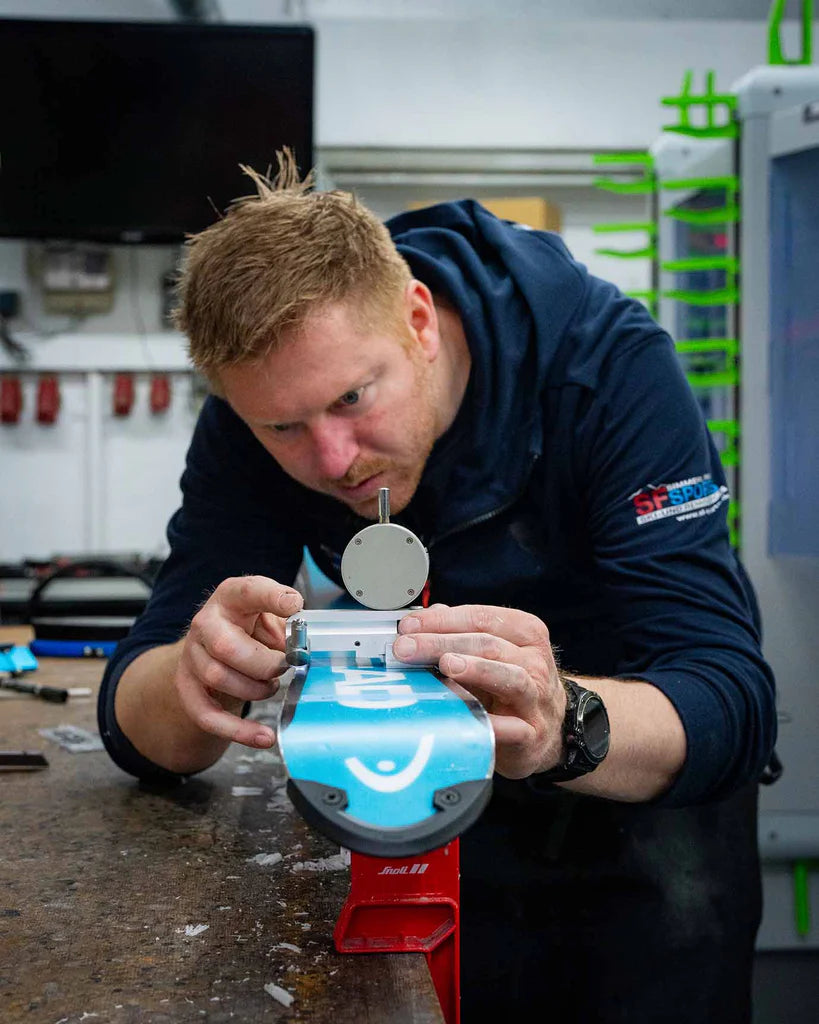
Tools needed:
- Base edge bevel gauge
- Straight edge
Tip: If the angle is too flat, you can file it down. If it is too large, only a complete base grind with a new structure will help.
Note: Precisely filing the base edge angle requires experience and special tools. This step can – and should – also be done by a specialist if you are unsure.
2. Professionally prepare side panels
To ensure the file lies cleanly against the edge, the side walls must be set back. This improves processing and protects the file.
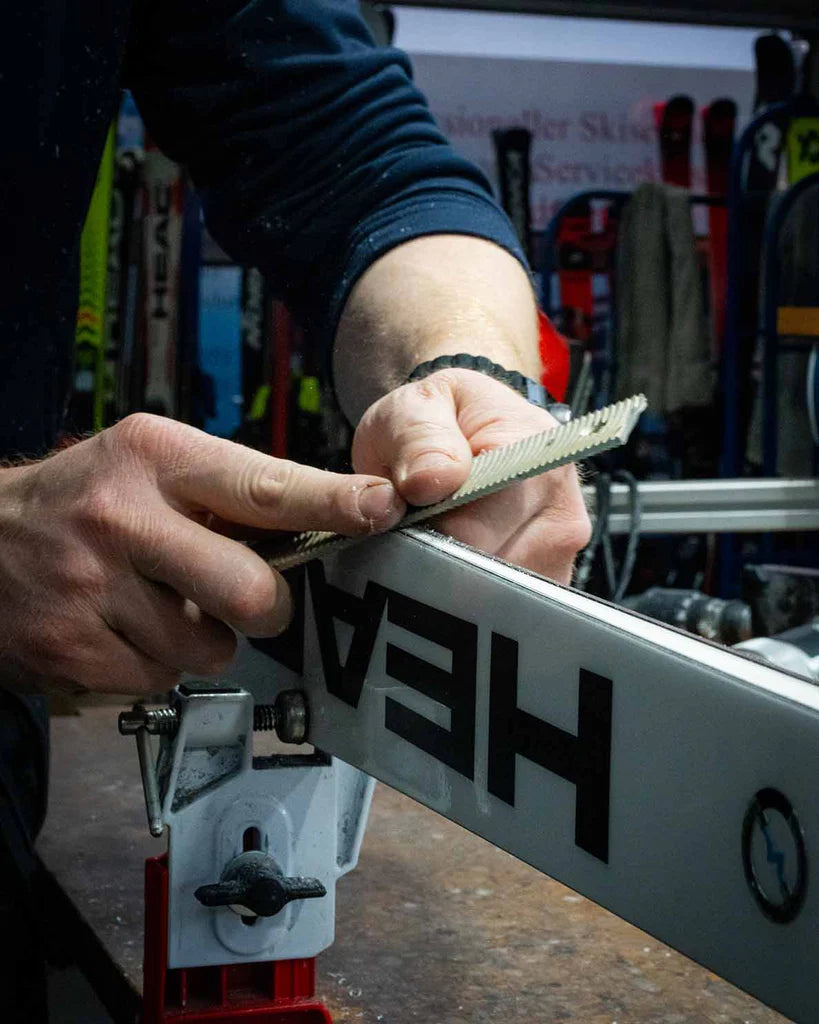
Step 1:
Beveling at the shovel & tail: with a body file.
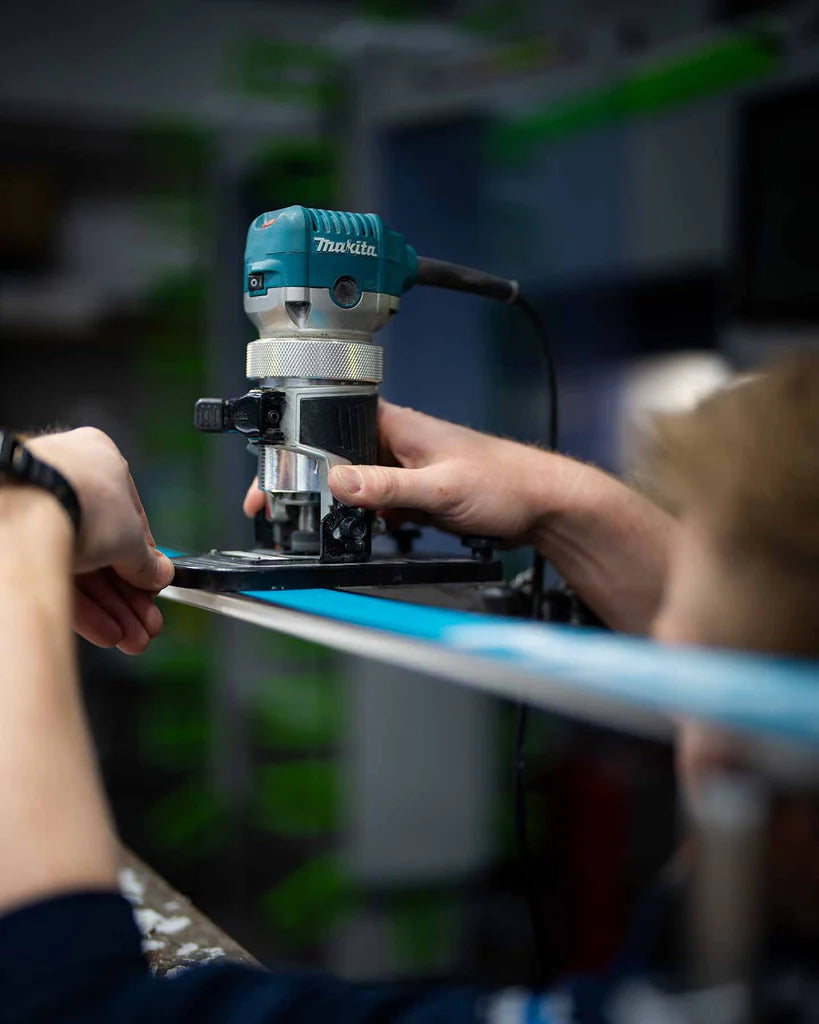
2nd step:
Cutting back Titanal & plastic: We recommend a special milling machine for this. However, it can also be done manually with a sidewall planer & 70° angle.
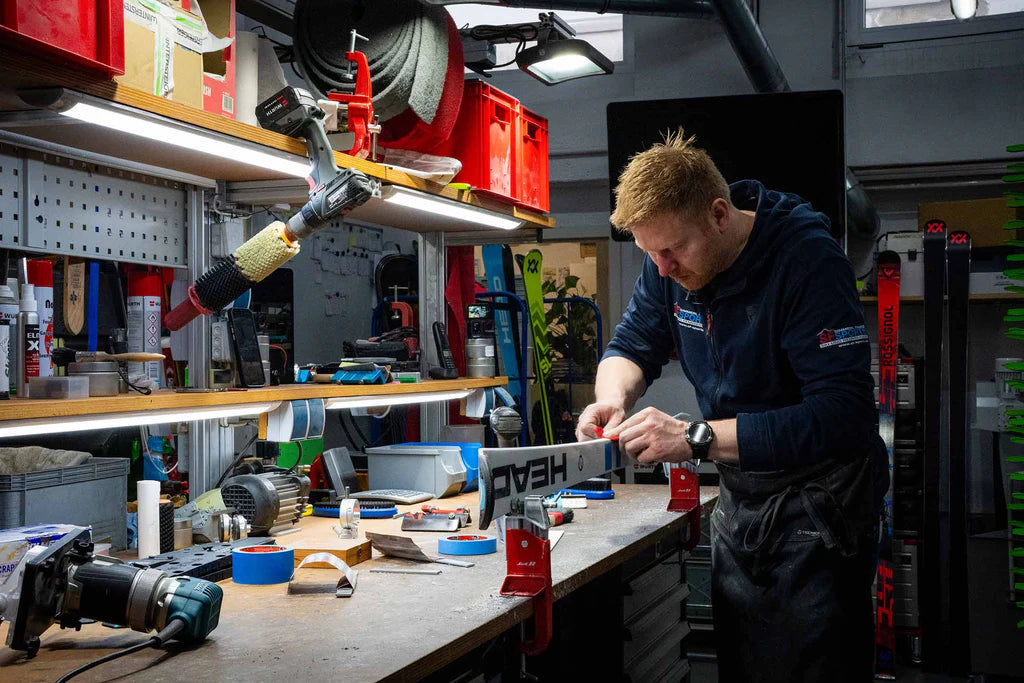
3. Step:
Smoothing & Waxing:K120 → K320 sandpaper, then work in paste wax with Fibertex.
4. Work Step:
Follow-up inspection:Has enough material been removed?
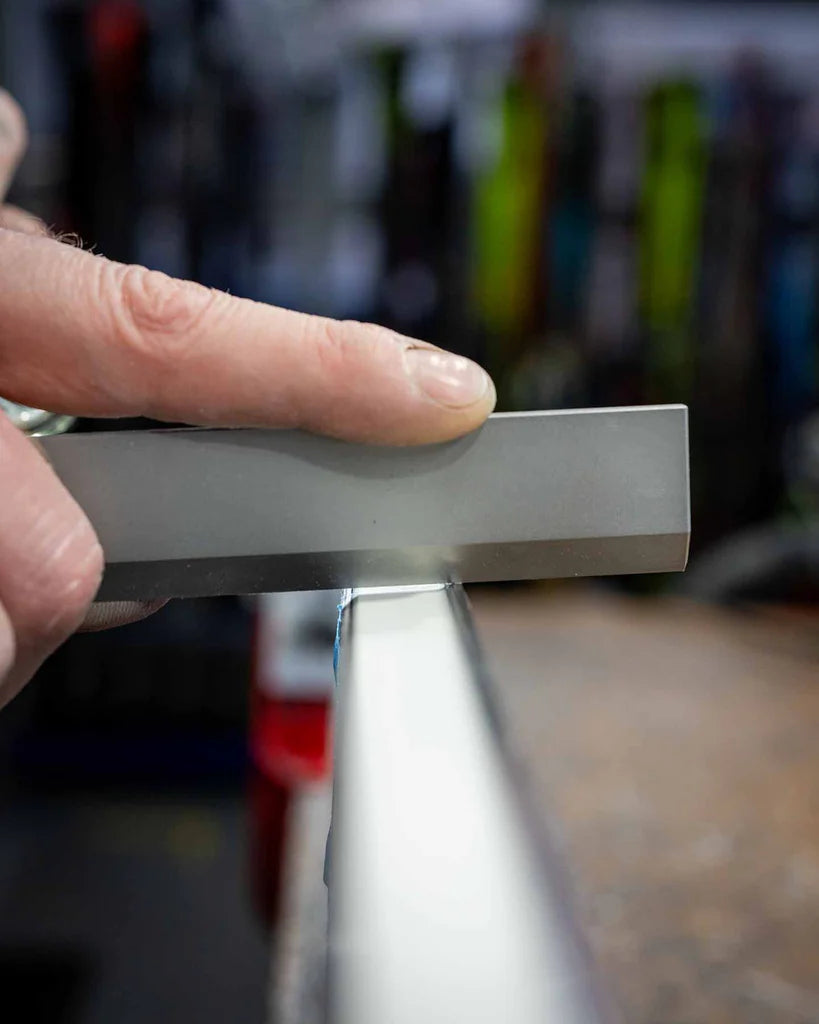
Tools needed:
- Body file
- Sidewall cutter
- 70° angle
- Sandpaper: K120 and K320, best to just wrap around an old file
- Paste wax
- Fibertex
- Straightedge
Practical tip: Even the initial filing of the sidewall and the first preparation require precision and practice. Many racers have this step done by professionals – or learn it as part of a professional service course.
3. Grinding & Structuring of the Base
A base grind is not always necessary, but it is highly recommended in certain cases. For example, if:
- the base edge is too deep ex works
- the ski is not flat
- the base structure is uneven or does not meet requirements
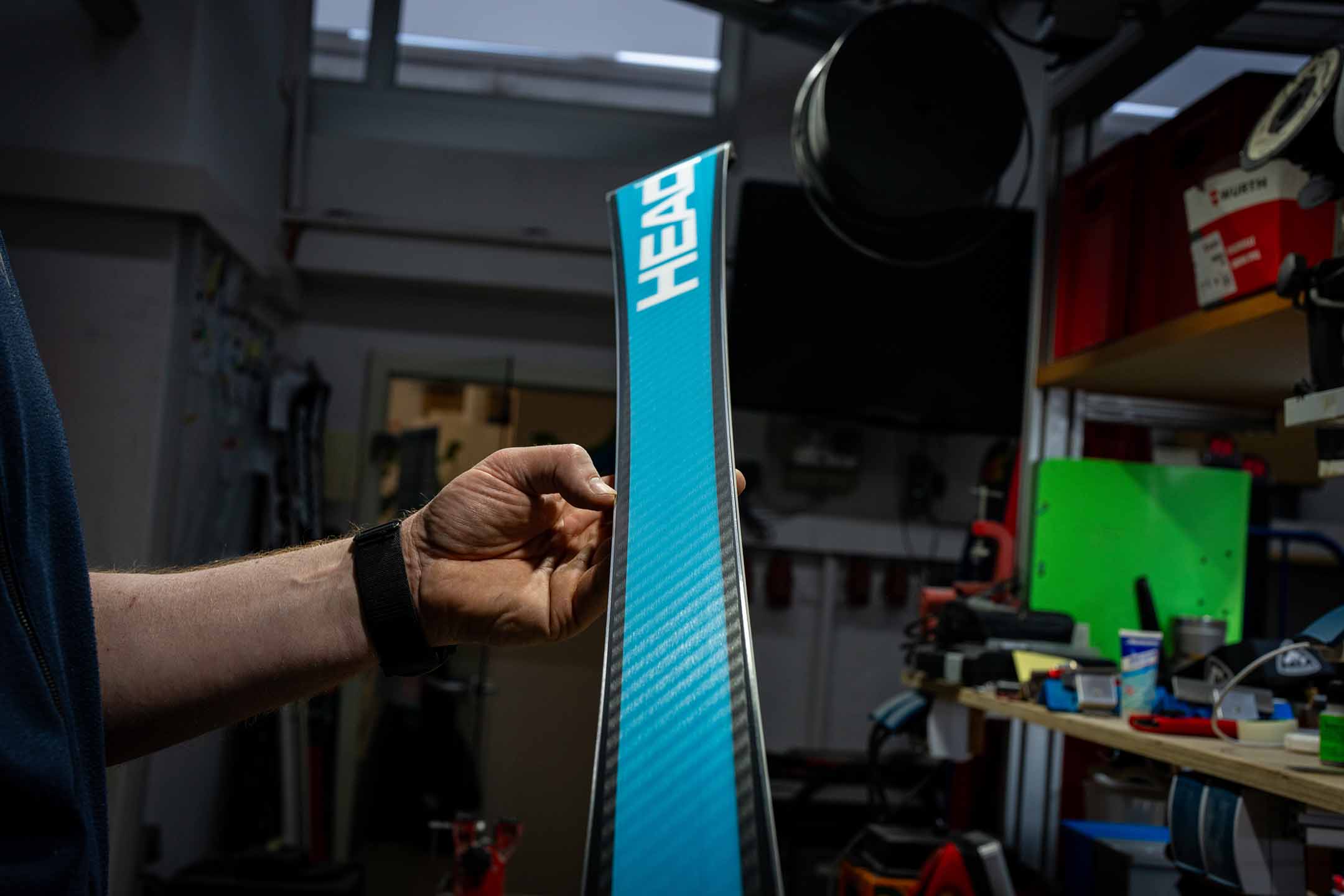
After grinding, the ski should be perfectly flat and have a structure adapted to the discipline and snow type. – For example, a fine cross-structure for slalom, as shown here:
Important: This step can only be performed in specialized shops with good ski grinding machines and professional staff. For race skis, we recommend structure grinds from Wintersteiger Race NC.
4. Edge Sharpening – The Key to Control
Now it's all about precision: The side edges are sharpened at a fixed angle, usually between 87° and 85°, depending on the discipline and age.
Procedure:
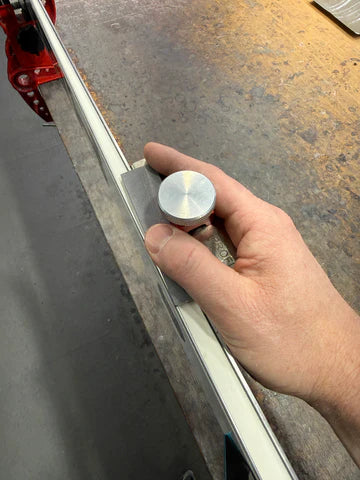
- Apply the angle & file evenly along the entire ski length until the angles are correct
- Remove burrs & smooth the edge with a fine diamond file
Tools required:
- Angle
- Coarse file
- If hardened, possibly an aluminum oxide stone
- Fine file
- Diamond file 600 and 1000
- Adhesive tape to protect the base
Important: The edge should be razor-sharp but not rough – this increases control, especially on icy slopes.
Tip: You can mark the edge with a felt-tip pen to see if the edge is evenly sharpened over the entire surface.
5. Waxing the base – for speed & protection
A well-saturated base is crucial for glide and longevity.
Recommendations:
- Slalom: should not be hot-waxed too often so that the skis remain nice and flat → ideally, maintain with a wax roller and/or paste wax
- Giant Slalom: 3 to 5 ironing passes
- Super-G & Downhill: wax 5 to 10 times for optimal base saturation
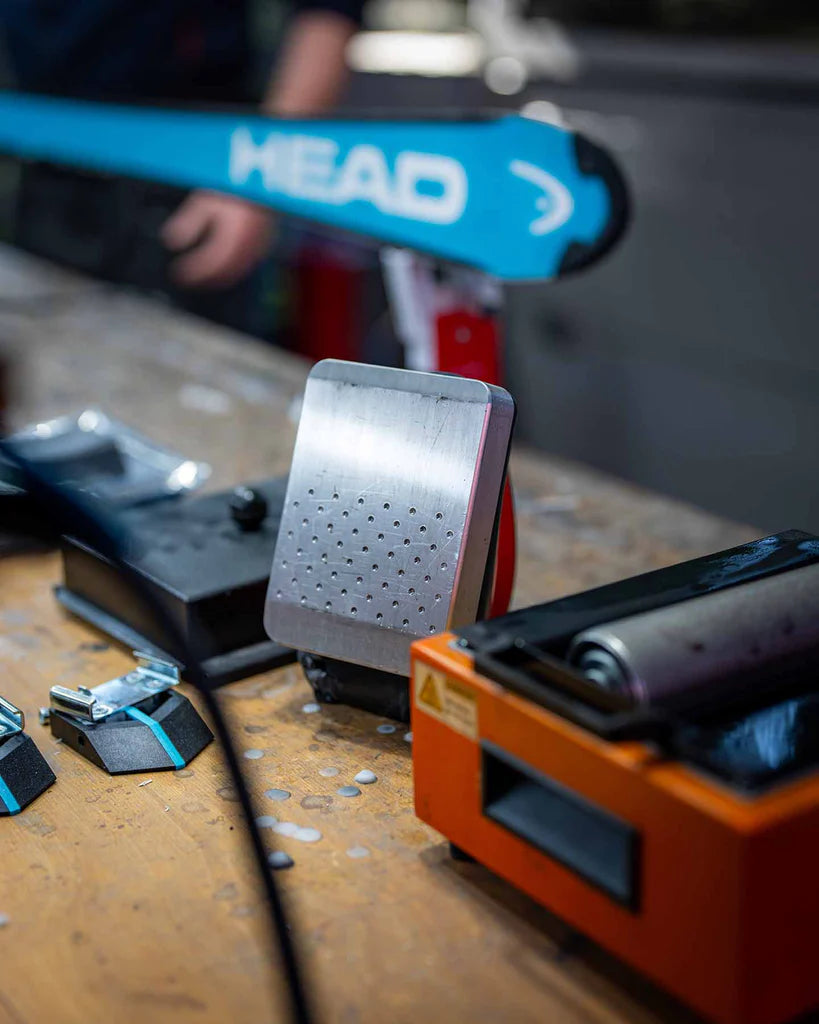
always brush thoroughly between wax cycles (e.g. steel or bronze brushes).
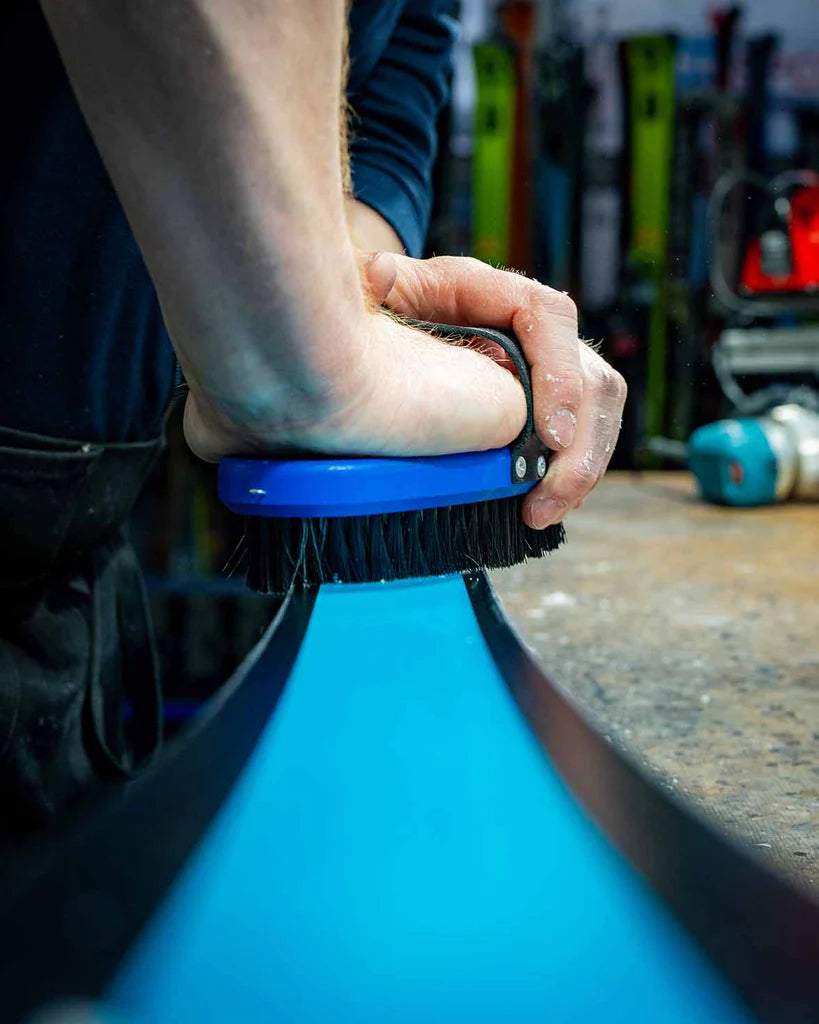
Tools you need:
- Iron
- Possibly a wax roller
- Scrapers
- Steel or bronze brush
- Horsehair brush
- Wax for priming and cleaning
- Wax for ski care
Tip: You should also take care of proper waxing and brushing yourself. In our waxing courses and preparation workshops, we show you how to wax your skis for racing.
Precision for Success
Proper preparation of new race skis is not a luxury, but a prerequisite for fast skis. The rule is: you don't have to do everything yourself, but you should know what is necessary. Steps 1 to 3 sometimes require special equipment and experience - we are happy to help you with these. Steps 4 and 5, however, everyone should learn themselves.
With the necessary knowledge and a little practice, you can do many service tasks yourself.
Further Topics
FAQ
FAQs on filing new skis
For recreational skiers, this is not strictly necessary.
For ambitious skiers, however, professional initial preparation is recommended.
For racers, this step is unavoidable, otherwise the ski cannot offer its maximum performance.
For the initial sharpening, high-quality steel files are used in combination with a precise edge angle.
Depending on the discipline, side edges often range from 87° to 85° and base edges from 0.2° to 1.2°.
It removes burrs and provides a clean, durable edge.
Yes. With the right tools and some experience, very good results can be achieved.
However, some steps require experience and a lot of practice, so it is advisable to have some work steps carried out by specialists.
After edge tuning, the base should be prepared with ski wax to achieve maximum performance.