
How to properly sharpen ski edges
Perfect Edge Grip at Race Level
Sharp ski edges are one of the most important prerequisites for control, precision, and speed on snow. While good ski wax improves glide, perfectly prepared edges determine how safely and precisely a ski can be ridden on hardpack, artificial snow, or ice.
Especially in racing, a few hundredths of a second often make all the difference. A cleanly ground edge ensures that the ski grips exactly where it should. It improves power transmission, increases safety, and allows for much more precise handling.
Many skiers invest a lot of time in choosing the right ski wax but neglect edge care. In fact, edge tuning is one of the most important components of any professional ski preparation.
In this guide, you will learn step-by-step how to sharpen, polish, and prepare ski edges to a race-level standard.
Why are sharp ski edges so important?
With every turn, the steel edges engage with the snow. They ensure that the ski can be controlled and that the applied force is transferred directly to the slope.
Dull or damaged edges often lead to:
- poorer edge grip
- unstable handling
- increased effort
- unsteady turn initiation
- loss of control on ice
Especially on modern artificial snow slopes, enormous stresses are placed on the edges. The sharp-edged crystals wear down the steel edge much more than natural powder snow.
Therefore, edges should be checked and maintained regularly.
Understanding the Anatomy of a Ski Edge
Before beginning the actual processing, one should understand the basic terms related to ski edges.
When talking about ski edges, we refer to:
Side Edge
The side edge largely determines edge grip.
The more aggressive the chosen angle, the more directly the ski grips on hard snow.
and the:
Base Edge (Bevel Edge)
The base edge primarily influences:
- Turn initiation
- Forgiveness
- Handling characteristics
For most racing applications, a base edge angle of 0.5° has proven effective.
and the:
Sidewall
The sidewall is located directly above the steel edge.
Before material can be removed from the edge, the sidewall often needs to be reset, and the Titanal and plastic removed.
Dominator's Racing Setup
For most racing applications, we recommend:
Base edge: 0.5°
Side edge: 87°
This combination offers:
- excellent edge grip
- precise turn initiation
- high running smoothness
- versatile applications
It is used by many racers in slalom, giant slalom, and technical racing.
The right workplace
Precise grinding starts with a stable workstation.
The ski must be:
- securely clamped
- vibration-free
- easily accessible
Good lighting significantly facilitates edge inspection.
Which tools are needed?
Edge Angle and Sidewall Cutters
Edge tools ensure exact angles and reproducible processing.
They form the basis of every professional edge preparation.
Files
The file is responsible for the actual material removal. Only with a high-quality file can precise angles and clean edges be created.
Diamond Files
Diamond files are used for fine finishing. They remove burrs and polish edges.
Check the bottom edge
The base edge significantly influences the skiing experience.
For race skis, a base edge of:
0.5°
has proven effective.
This setting ensures:
- fast turn initiation
- direct edge grip
- precise control
The base edge should be changed as rarely as possible, as corrections are time-consuming and costly in terms of material. It is important that the base edge has no damage. The base edge should be measured regularly, as the angle can change for various reasons, for example, due to the flexing and twisting of the skis while skiing, or due to damage, or due to ski preparation.

Step 2: Reset Side Panel
All race skis have thick sidewalls made of Titanal, plastic or composite material.
These often lie flush with the edge, preventing the file from working cleanly.
Before starting the actual edge tuning, it must therefore be checked whether the sidewall offers sufficient clearance.
Why is this important?
If the sidewall is not set back:
- the file will jam on the plastic and get clogged.
- the edge will not be fully processed
- the angle will change unintentionally
The result is uneven edges and poor edge grip.
Check the Sidewall
Check along the entire edge:
- Is plastic overlapping the steel edge?
- Does the file touch the sidewall?
- Are there grinding marks visible?
If so, the sidewall should be set back.
See below for how the sidewall should be prepared.
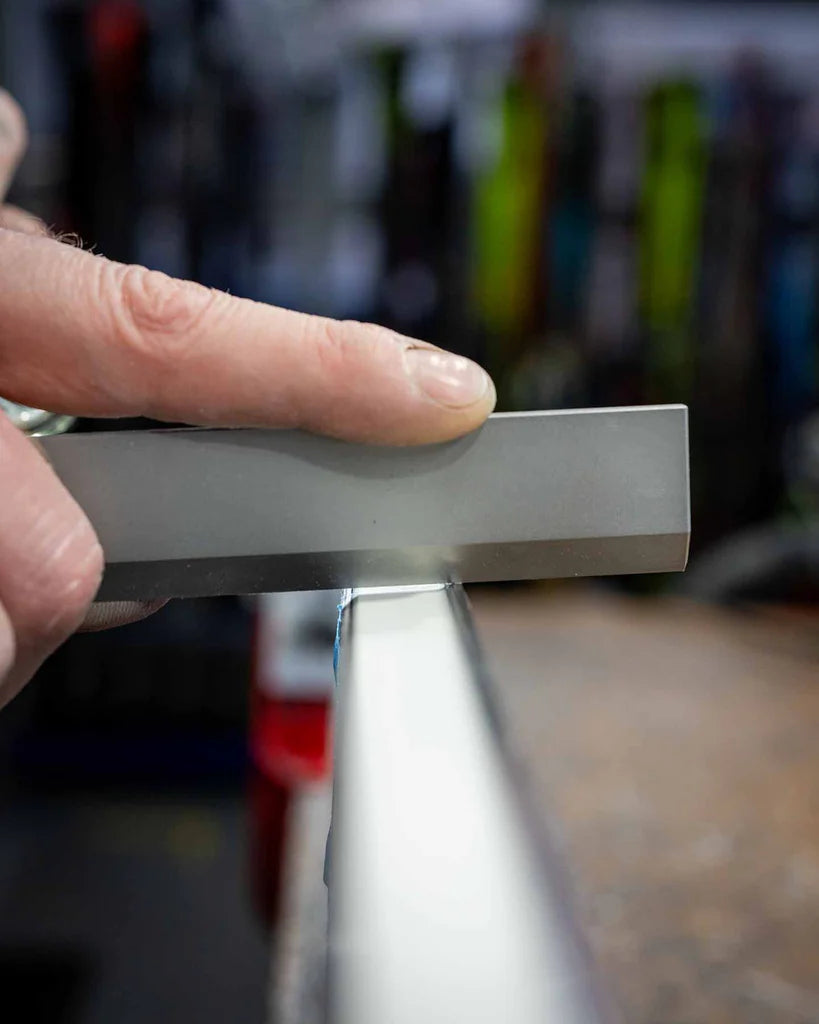
Carefully remove material
When resetting, the following applies:
- remove only as much as necessary
- work evenly
- do not create nicks
The goal is to make the steel edge fully accessible.

Step 2: Sand the side edge
After the sidewall has been prepared, the actual edge tuning begins.
For most racing applications, a side edge angle of 87° is used.
This angle offers:
- high edge grip
- direct power transmission
- precise handling
Correct Use of the File
The file is inserted into the edge tool.
Important:
- clean contact surface
- correct direction
- clamp at a slight angle, both ends of the file should run over the edge
- secure guidance
A dirty or damaged file should not be used.
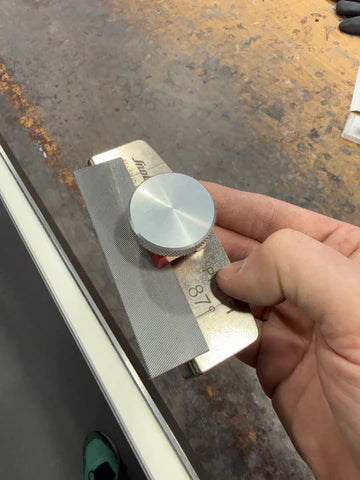
The Right Movement
The file is guided with steady, even strokes.
The following applies:
- even, light pressure
- not too fast
- no jerky movements
- process the entire edge length
Many small, clean strokes lead to significantly better results than a few aggressive movements.
Control material removal
After a few strokes, the edge should be checked.
Pay attention to:
- uniform surface
- continuous grind
- no more damage
- burr formation
The less material removed, the longer the edge will last.
Why 87°?
Many racers wonder why 87° is often used as the standard.
The advantage lies in the balance between:
- maximum edge grip
- sufficient durability
- controllable handling
While a more aggressive angle can generate even more grip, it often leads to higher wear and more challenging handling.
For most racing applications, 87° therefore represents an excellent compromise.

Step 3: Polish with diamond files
After filing, the edge is sharp but not yet fully prepared. Material removal creates fine metal burrs and microscopic imperfections that can impair edge grip.
This is precisely where diamond files come in.
In professional race service, polishing the edge is one of the most important steps.
Why polish?
Polishing provides:
- smoother edge surfaces
- less friction
- better edge grip
- longer durability
- easier turn transitions
A cleanly polished edge feels significantly smoother and more precise than a purely filed edge.
How to polish correctly
Guide the diamond file with light pressure.
Important:
- even movements
- light pressure
- work the entire edge length
Diamond files should not cut, but polish.
Too much pressure worsens the result.
Use the diamond file one to two passes per edge to polish the surface and remove burrs.
After filing and polishing, remaining burrs must be removed.
Burrs are caused by:
- Material removal
- Stone contact
- Ice
- Artificial snow
Even the smallest burrs can cause the ski to:
- run erratically
- grip unevenly
- turn poorly
Deburring the Shovel and Ski Tail
In race service, the shovel and ski tail are often lightly deburred.
This results in:
- smoother turn initiation
- calmer handling
- improved forgiveness
The actual race edge, of course, remains completely sharp.
Camber Angle in Racing
The requirements for the edge differ depending on the discipline.
Slalom
Typically:
- 0.2 to 0.5° base edge
- 87° to 85° side edge
Maximum grip for quick changes of direction.
Giant Slalom
Typically:
- 0.5° base edge
- 87° side edge
Optimal combination of precision and smooth running.
Super-G
Typically:
- 0.5° to 0.7° base edge
- 87° side edge
Slightly higher stability at high speeds.
Downhill
Typically:
- 0.7° to 1.4° base edge
- 87° side edge
High running smoothness and controllable handling.
The most common mistakes when sharpening edges
Too Much Pressure
Many skiers believe that more pressure automatically leads to sharper edges.
The opposite is true.
Too much pressure:
- creates uneven edges
- stresses the file
- reduces precision
If the file no longer cuts easily, it is worn out!
Diamond file used too frequently
Often, one or two passes with a normal fine file are enough.
Repeated polishing with the diamond file makes the edge surface finer and finer, and the edge can no longer grip optimally on hard surfaces.
Incorrect Angles
Different angles on the left and right skis lead to:
- asymmetrical ski behavior
- imprecise edge grip
- poor control
Therefore, angles should always be precisely maintained.
Professional tools are particularly important. If the file cannot be optimally clamped and has play in the angle, or if the angle's support surface is not exact and stable, good results cannot be achieved.
When does a ski need to be re-ground?
Sometimes, regular resharpening is no longer sufficient.
Typical reasons:
- the base edge angle is no longer correct or is uneven
- stone damage
- hard spots in the edge
- rust damage
- uneven angles
In these cases, a professional service or machine sharpening can be useful.
Afterward, regular maintenance can be done by hand again.
The connection between edge, base, and ski wax
Many skiers treat edge service and ski wax as separate issues.
In fact, both areas influence each other.
Perfect performance is only achieved through the combination of:
- sharp edges
- suitable ski wax
- clean base structure
- correct application
A perfect edge is of little use if the base is dry or poorly waxed.
Likewise, even the best race wax cannot compensate for dull edges.
The perfect race service
Professional race preparation includes:
1. Check the base
Check structure and condition.
2. Check the base edge
Maintain 0.5°.
3. Prepare the sidewall
Create free access to the edge.
4. File the side edge
Create an 87° race angle.
5. Polish
Work with several diamond files.
6. Deburr
Adjust shovel and tail of the ski.
7. Wax the skis
Prepare and protect the base.
8. Brush out
Expose the structure.
Only the interaction of all these steps ensures maximum performance on snow.
What tools do you need?
Angle and Sidewall Cutters
For precise angles and reproducible results.
Files
For controlled material removal.
Diamond Files
For finishing and polishing.
FAQ
Frequent questions about sharpening edges
As sharp as necessary and as gentle on the material as possible. For race skis, an 87° side edge and a 0.5° base edge have proven effective.
Racers often check their edges after every training session or race. Recreational skiers should check their edges regularly and resharpen them as needed.
We recommend at least the 600 and 1000 grit diamonds as basic equipment for optimal preparation.
So that the file can fully work on the steel edge and does not rest on the plastic.
The plastic would clog the file, the titanal is too hard for the files and cannot be worked on in this way.
Polished edges offer better edge grip, higher precision, and longer tool life.
For most racing applications:
- 87° side edge
- 0.5° base edge
In case of severe damage, major angle corrections, or after intensive racing.
A race ski should be sharpened two to three times per season with proper care.
Further Topics